In November, many restaurant managers review year-end maintenance, insurance renewals, and budgets for the coming year. It is a practical time to gather hood-cleaning reports, suppression-system tags, and service records while planning the next inspection. However, an annual paperwork review is not a substitute for the professional service schedule required for a commercial kitchen suppression system.
For most wet-chemical hood systems, professional inspection, testing, and maintenance are required at least every six months, not once a year. Owners should also conduct and document monthly visual checks. An annual insurance or compliance review can help identify missing records, but it does not replace either interval.
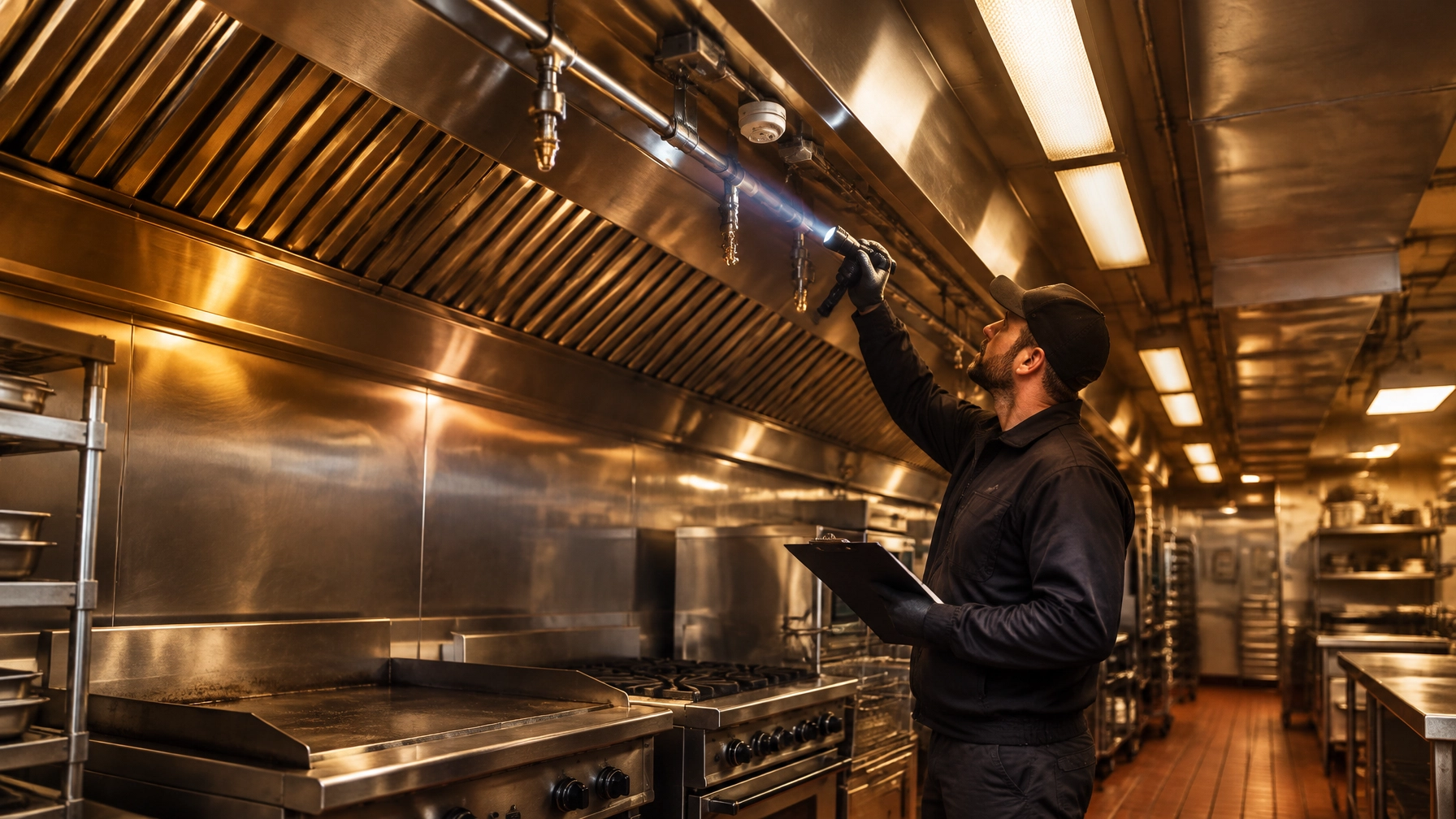
A commercial kitchen fire suppression system protects cooking appliances, the hood and plenum, and the exhaust duct. In an Ansul system, for example, automatic detection or a manual pull station can trigger discharge of wet-chemical agent. System actuation is also designed to operate connected controls, such as a gas or fuel shut-off.
A qualified technician follows the specific system’s listing and manufacturer procedures. A service visit typically includes checking:
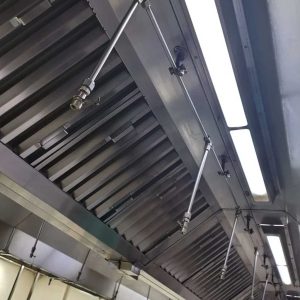
For an Ansul system inspection, follow the requirements for the installed model; don’t assume every make or configuration has identical components or procedures.
NFPA 96 calls for fire-extinguishing system maintenance by a properly trained, qualified, and certified person at least every six months. It also requires testing the system’s actuation and control components, including manual pull stations, detectors, and actuators, in accordance with manufacturer procedures. Ansul’s R-102 manual likewise specifies maintenance at six-month intervals. Check the applicable requirements for your system and local authority having jurisdiction; an “annual certification” does not replace this semiannual service.
Between professional visits, assign a responsible employee to complete a monthly visual check, following the manufacturer’s owner instructions. Confirm the system appears ready for operation; the pull station is accessible; tamper indicators and seals are intact; the gauge, if present, appears in its normal range; nozzle caps are present and undamaged; and there is no visible damage or change to the protected cooking equipment. Record the date, checker, findings, and any follow-up needed.
These are visual checks, not repairs or operational tests. Do not adjust nozzles, links, piping, or release components yourself. Contact a qualified technician if something looks damaged, missing, or out of place.
Restaurant teams can prevent many routine deficiencies by paying attention to details during regular kitchen work. Inspectors commonly flag:
Coordinate the service visit after hood cleaning. Cleaning crews may disturb suppression nozzles while removing filters or working around the hood. Arrange for a qualified suppression-system technician to check the system after cleaning, and ask the cleaning provider to document its work separately. Cleaning does not replace fire suppression service, and suppression service does not replace required hood and duct cleaning.

Create one file, digital or on site, with the current system tag, itemized inspection and maintenance reports, monthly owner-check logs, hood-cleaning reports, and documentation of deficiencies and completed repairs. Keep relevant system and manufacturer information with those records, and make them available when requested by your insurer or the authority having jurisdiction.
Fort Wayne’s Fire Prevention Code requires an itemized report following inspection, maintenance, repair, or replacement of fire-protection systems, including fire-extinguishing hood systems. The report must identify pass/fail status, deficiencies, and work completed; the servicing company forwards it to the Fire Department’s Code Enforcement Division, Fire Marshal, or designee. Check that your copy matches the service performed and retain it with your insurance-renewal documents.
The hood-cleaning contractor’s label and report should also be retained. They document cleaning activity, but they are not the suppression-system inspection tag or service report.

There is no single inspection cost that applies to every kitchen. Pricing depends on the system type, number of protected appliances and nozzles, service history, access, and whether repairs or replacement components are needed. Request an itemized quote that separates scheduled inspection and maintenance from corrective work.
If a year-end review shows that service is due, call promptly to ask about scheduling and same-day availability; timing depends on technician availability and the work required. TJ Nowak Supply is a family-owned Fort Wayne provider serving the region since 1946. Its certified technicians design, install, inspect, and service suppression systems and replace components such as pull boxes. The team provides local fire protection support in Fort Wayne, IN and serves Northern Indiana, including Columbia City, Auburn, Warsaw, Huntington, and Angola. For sites farther out, ask about custom logistics.
Review TJ Nowak Supply’s fire protection services or request service online. For information about broader inspection planning, see five things Fort Wayne businesses need to know before scheduling a fire suppression inspection.
For wet-chemical kitchen hood systems, professional maintenance is generally required at least every six months under the applicable standards and manufacturer procedures. Confirm the requirements for your specific system and local authority. An annual insurance review does not replace semiannual service.
Follow the manufacturer’s owner instructions and visually confirm the system appears ready, access to the manual pull station is clear, visible seals and indicators are intact, gauges appear normal where provided, nozzle caps are present, and components show no obvious damage. Log the check and report concerns to a qualified technician.
Schedule suppression service after hood cleaning when possible. Cleaning may disturb nozzles or other system components, so a post-cleaning check helps confirm they remain correctly positioned and ready.
Keep the service tag, itemized technician reports, monthly visual-check logs, hood-cleaning labels and reports, and records of corrective work. Fort Wayne requires the servicing entity to forward the applicable itemized report to the fire authority; retain your copy as well.
Call TJ Nowak Supply at (260) 424-1901 with your system type, last service date, and any known deficiencies. The team can confirm current scheduling and provide a quote based on the system and work needed.
Use November to verify your records, confirm your next semiannual service date, and make sure hood cleaning and suppression maintenance are coordinated. For restaurant fire protection in Fort Wayne, work with a qualified local provider that can inspect the system, document findings, and address needed repairs.
Get a quote today. Call TJ Nowak Supply at (260) 424-1901 to schedule service. For stocked fire protection products, order online for fast delivery in Fort Wayne.