
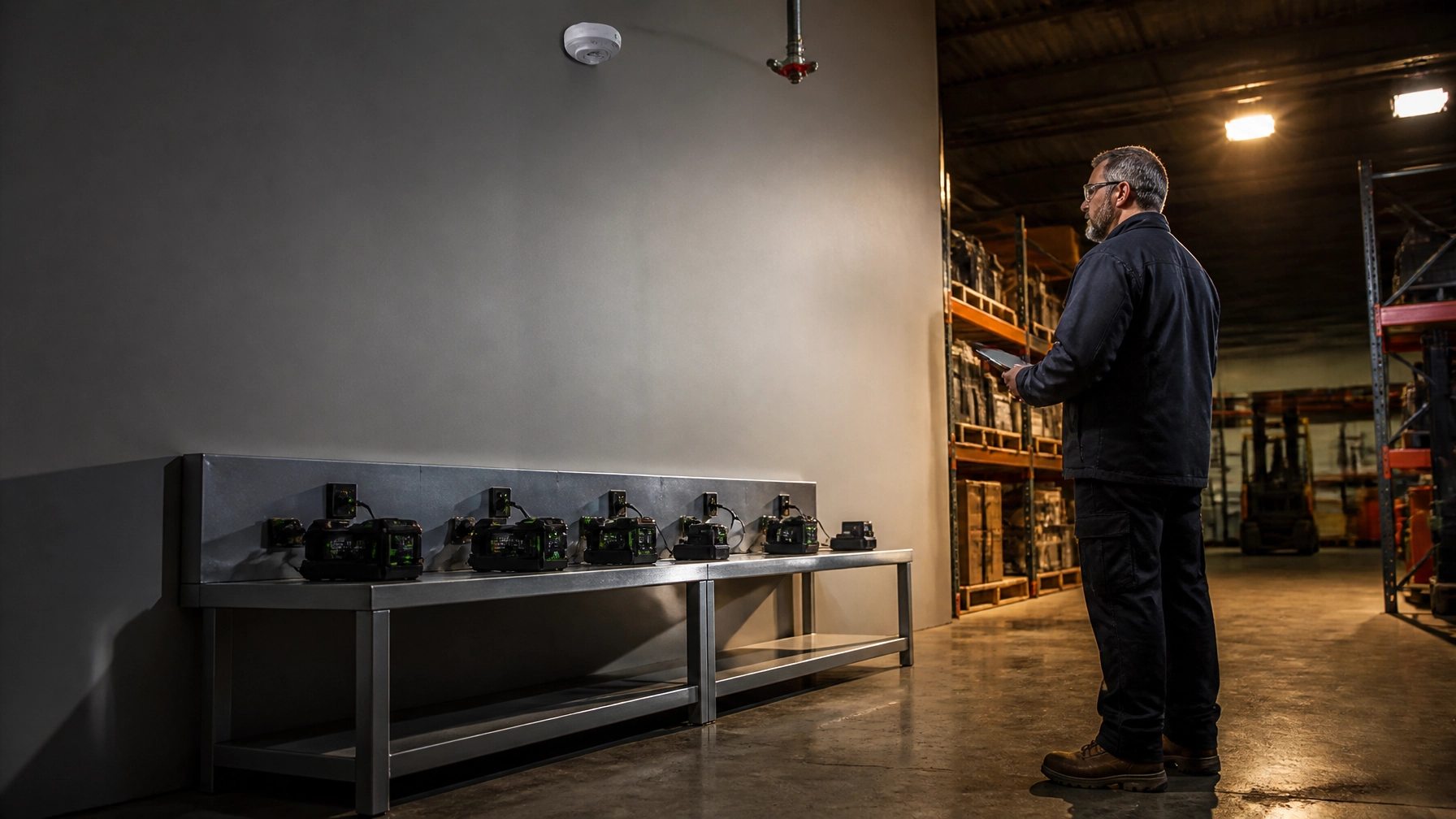
As Fort Wayne facilities prepare for Fire Prevention Week, October 4–10, 2026, many teams are eagerly charging power tools, forklifts, radios, e-bikes, and other equipment needed to keep operations moving. This year’s theme, “Charge into Fire Safety,” offers a timely opportunity to review how lithium-ion batteries are charged, stored, inspected, and removed from service.
Outdoor work, busy production schedules, and well-maintained equipment support productive operations. However, facility managers must prioritize practical controls because a standard fire suppression system is not a guaranteed solution for every lithium-ion battery incident.
Lithium-ion battery fires can involve rapid heat release, flammable vapors, and re-ignition after flames appear to be out. The right approach combines safe charging procedures, appropriate storage, early detection, properly selected portable extinguishers, employee training, and a professional fire suppression system inspection.
Fire protection is the broader program used to protect people, property, and business continuity. It can include:
Fire suppression is one part of that larger program. Depending on the hazard, a suppression system may use water, wet chemicals, clean agents, inert gases, or another listed extinguishing method.
For lithium-ion battery areas, automatic sprinklers and detection systems may help control surrounding combustibles, cool nearby equipment, slow fire spread, and provide early warning. In some facilities, specialized battery cabinets, enclosures, ventilation, separation, or engineered suppression systems may also be appropriate.
However, lithium-ion battery thermal runaway is different from a simple ordinary-combustible fire. A damaged cell can continue generating heat internally, spread from cell to cell, and reignite. A sprinkler system may control the building fire without immediately stopping the battery’s internal reaction.
The correct design depends on the battery chemistry, quantity, energy capacity, equipment type, storage arrangement, charging process, building construction, and requirements of the authority having jurisdiction. Facilities should not assume that an existing sprinkler or extinguisher setup automatically meets the needs of a new battery-charging operation.
Charging stations should be treated as a managed workplace hazard rather than an informal convenience area. Before Fire Prevention Week, review each charging location and correct conditions that could allow a small incident to become a larger facility fire.
Use only chargers approved for the specific battery or device. A charger that fits a connection is not necessarily compatible with the battery’s voltage, controls, or charging requirements.
Inspect chargers, cords, plugs, and battery housings for damage. Remove equipment from service if it has exposed wiring, cracked insulation, overheating, or loose connections.
Whenever possible:
Employees should stop using or charging a battery that becomes unusually hot, swollen, cracked, discolored, wet, or damaged. Odors, hissing, popping, smoke, or visible leakage are also warning signs.
Do not place a suspect battery back into normal storage or throw it into a general waste container. Follow the manufacturer’s instructions and your facility’s emergency and hazardous-material procedures. If the battery is smoking or burning, evacuate, close doors if safe, call 911, and wait for the fire department.
For additional public-safety guidance, review the NFPA lithium-ion battery resources and U.S. Fire Administration battery safety guidance.

Battery storage requirements vary by facility and application, but several basic controls are broadly useful.
Store batteries in a cool, dry area away from heaters, direct sunlight, ignition sources, and combustible storage. Keep loose batteries from contacting coins, keys, tools, or other conductive metal objects. Where practical, use original packaging, individual cases, or protective terminal covers.
Facilities should also separate:
A designated quarantine process is essential. Employees should know where to place a swollen, dropped, punctured, leaking, or overheated battery and who must be notified. Do not improvise a quarantine container without reviewing the battery type, size, condition, and manufacturer or fire department guidance.
Warehouses, tool rooms, fleet facilities, manufacturers, schools, and other workplaces may need a site-specific assessment to determine whether metal cabinets, fire-rated enclosures, outdoor storage, increased separation, detection, ventilation, or engineered suppression is appropriate.
Portable extinguishers can provide an important first response when a fire is small, an exit remains available, and the employee is trained and authorized to act. They are not a reason to delay evacuation or approach a rapidly heating, venting, or smoking battery.
A Class C rating addresses fires involving energized electrical equipment, but it does not make an extinguisher a universal lithium-ion battery solution. Extinguisher selection should account for the surrounding materials, the equipment involved, the battery installation, and the manufacturer’s instructions.
Employees should never fight a battery fire if:
TJ Nowak Supply provides fire extinguisher inspection, service, tagging, refilling, and hydro-testing, including NFPA 10-compliant service and in-house DOT hydro-testing. Our team can help verify that extinguishers are correctly selected, accessible, properly mounted, and documented for your facility.
A fire suppression system inspection is more than checking whether equipment is physically present. A qualified inspection can help identify whether the system remains appropriate for the current hazard and whether changes to your facility have created new risks.
Ask your fire protection provider to review:
TJ Nowak’s fire protection services include design, installation, inspection, repairs, monitoring, extinguishers, alarms, sprinklers, special hazards, and facility hazard assessments. A site review can help your team determine whether an existing system is suitable or whether additional engineering is required.

A phone battery, cordless tool pack, electric vehicle battery, and stationary energy-storage system do not present identical hazards. Inventory and use conditions matter.
Cardboard boxes, rags, packaging materials, and flammable liquids can allow a charging incident to spread quickly. Keep charging stations orderly and separated.
Swelling, dents, punctures, odor, heat, or leakage should trigger removal from service: not another shift of use.
The correct extinguisher and response plan depend on the full hazard. A portable extinguisher may address flames but not eliminate the risk of internal battery re-ignition.
Adding battery racks, charging cabinets, forklifts, e-bikes, or energy-storage equipment can change the hazard profile. Request a review before the new equipment becomes part of normal operations.
There is no responsible one-size-fits-all cost for lithium-ion fire protection. Pricing depends on the number and type of extinguishers, system design, inspection scope, site size, access, required repairs, detection needs, and whether an engineered solution is necessary. TJ Nowak Supply can provide a written quote after understanding your facility and the service required.
For urgent needs, same-day dispatch may be available from our Fort Wayne location, depending on technician and equipment availability. We provide inspection, service, repair, and delivery support throughout Northern Indiana, including Columbia City, Auburn, Warsaw, Huntington, and Angola. For sites farther away, our team can coordinate custom logistics based on the project scope.
TJ Nowak Supply is a family-owned, locally operated provider trusted in the region since 1946. Our certified technicians and in-house capabilities help businesses address fire protection needs with practical guidance and responsive service.
It may control surrounding flames, cool nearby materials, and slow fire spread, but it is not guaranteed to stop thermal runaway inside every battery. The system should be evaluated against the specific battery hazard and facility layout.
Only trained and authorized employees should attempt incipient-stage firefighting, and only when the fire is small, an exit is clear, and the extinguisher is appropriate for the hazard. Evacuation and calling 911 take priority.
Inspection and testing intervals depend on the system type, applicable standards, manufacturer requirements, local code, and the authority having jurisdiction. A qualified provider can establish the appropriate schedule and document deficiencies.
Stop using and charging it. Keep people away, avoid handling it unnecessarily, and follow your manufacturer, fire department, and approved battery-recycling or hazardous-waste procedures. Do not place it in ordinary trash.
Yes. TJ Nowak can discuss a facility hazard assessment, extinguisher service, alarm and sprinkler concerns, special-hazard suppression, and related fire protection needs. Start with our request service page or call the Fort Wayne office at (260) 424-1901.
Fire Prevention Week is a useful deadline for action, but battery safety should continue throughout the year. Review charging areas, remove damaged equipment from service, verify extinguisher access, and schedule a professional assessment before a new battery-related hazard affects your people or your uptime.
Get a quote today.
Call TJ Nowak Supply.
Order online for fast delivery in Fort Wayne.