As facility managers across Northern Indiana review fire protection programs for 2026, many are eagerly anticipating more efficient ways to document inspections, manage equipment, and reduce unnecessary administrative work. However, NFPA 10’s new performance-based inspection option does not give businesses permission to simply stop monthly visual checks or ignore annual maintenance.
The 2026 edition of NFPA 10, Standard for Portable Fire Extinguishers, introduces optional flexibility for certain inspection programs, including approaches based on documented performance history, risk, and: where approved: electronic monitoring. These options must be evaluated carefully against OSHA requirements, the adopted fire code, the authority having jurisdiction (AHJ), manufacturer instructions, and your workplace’s actual hazards.
For most businesses, the practical answer is straightforward: continue your established inspection and maintenance program unless the appropriate authorities have approved a documented alternative.
NFPA 10 establishes requirements intended to keep portable fire extinguishers ready for use as the first line of defense against limited-size fires. It addresses:
Portable extinguishers are one part of a broader fire protection service program. They do not replace automatic sprinklers, kitchen suppression systems, alarm systems, emergency planning, or other required fire suppression equipment.
The 2026 edition is the current NFPA 10 publication, but NFPA standards are not automatically law everywhere. Adoption and enforcement depend on the applicable jurisdiction and AHJ.
Traditional extinguisher inspection programs generally use a fixed schedule, with visual inspections conducted at least monthly or at intervals not exceeding 30 days under common NFPA and OSHA expectations.
NFPA 10-2026 provides an optional performance-based path that may allow an owner or owner’s agent to establish inspection methods and frequencies based on factors such as:
This approach is intended to make inspection programs more responsive to actual conditions. A controlled office environment with a strong inspection history may present a different risk than a fabrication shop, commercial kitchen, chemical-processing area, or outdoor construction site.
The important limitation is that performance-based inspection is an optional, documented program, not an automatic exemption. Your facility must have credible records, a defensible risk evaluation, and acceptance from the AHJ before changing inspection practices. Depending on the situation, third-party review or additional technical justification may also be expected.
Do not assume so.
OSHA 29 CFR 1910.157(e)(2) states that portable fire extinguishers provided for employee use must be visually inspected monthly. OSHA also places responsibility for inspection, maintenance, and testing on the employer.
That means a facility manager should not reduce or eliminate monthly visual inspections merely because the 2026 edition of NFPA 10 contains performance-based provisions. Before changing your program, confirm all of the following:
Until those questions are answered, continue the traditional monthly inspection process.
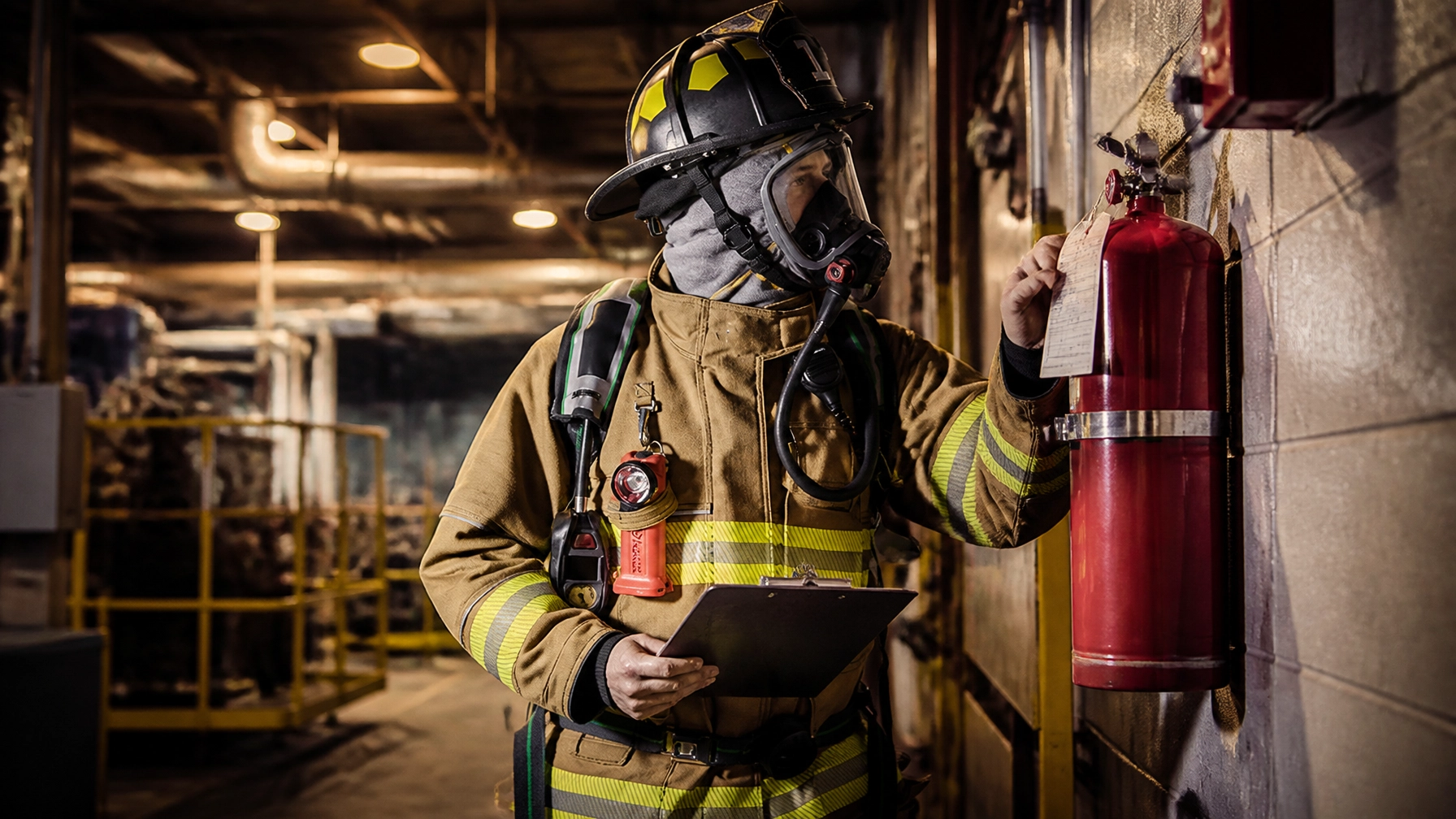
A monthly visual inspection should identify obvious problems, including:
Employees who perform these checks should know what to look for and how to report deficiencies. A visual inspection is not the same as annual maintenance performed by a qualified technician.

Even when a performance-based plan is approved, several core responsibilities generally remain.
OSHA requires an annual maintenance check for workplace portable extinguishers. Annual maintenance is more detailed than a routine visual inspection and should be completed by a qualified fire protection technician.
The technician may evaluate the extinguisher’s condition, operating components, pressure, labeling, service history, and suitability for continued use. Repairs, recharging, replacement, or additional testing may be necessary.
Certain extinguishers require periodic internal examination and maintenance. Hydrostatic testing is required at intervals that vary by extinguisher type, cylinder, shell, and applicable regulation.
Testing may also be required sooner if an extinguisher shows signs of corrosion, mechanical damage, exposure to fire, or other conditions that affect cylinder integrity. Facilities should maintain certification records for required testing and service.
NFPA 10 and OSHA requirements do not eliminate the need to follow manufacturer instructions. Extinguishers must be serviced using compatible parts, agents, procedures, and equipment.
The local AHJ may impose requirements that are more specific than a general summary of NFPA 10. Your insurance carrier, landlord, corporate safety program, or customer contract may also require documented service at a particular interval.
In other words, a new standard does not override every other rule affecting your facility.
Schedule professional inspection and maintenance when:
For facilities in Fort Wayne, a local technician can review the equipment in its actual environment rather than relying only on a count of cylinders. That matters when extinguishers are exposed to welding areas, grease, dust, vehicle traffic, outdoor weather, or production hazards.
TJ Nowak Supply provides fire protection support for local businesses, industrial facilities, contractors, and other organizations. Our trained specialists can help evaluate portable extinguishers, replacement components, service needs, and related fire suppression requirements.
There is no responsible one-size-fits-all price for this service. The total cost depends on:
A low-cost visual check is not equivalent to complete annual maintenance, hydrostatic testing, or a full fire protection review. Request a site-specific quote so the scope is clear before work begins.
TJ Nowak Supply offers rapid-response service and fast turnaround when equipment must be repaired, replaced, or returned to service. Same-day availability depends on technician schedules, equipment condition, parts, and the size of the request, but contacting a local provider can reduce delays compared with waiting for an out-of-area vendor.
The 2026 edition is published, but adoption varies. Confirm the edition and requirements with your AHJ before changing your program.
A performance-based approach may change how inspection frequency is determined, but it does not excuse poor documentation, skipped maintenance, defective equipment, or inadequate coverage.
Do not rely on an informal conversation or a vendor’s general recommendation. Obtain clear direction from the AHJ and confirm OSHA implications before adopting an alternative.
NFPA 10 applies to portable extinguishers. Kitchen hood suppression, industrial suppression, and other fixed systems have separate inspection, testing, and maintenance requirements.
Keep inspection reports, annual maintenance records, hydrostatic test certificates, deficiency corrections, and approval documents organized and available.

No. Do not assume monthly inspections are eliminated. OSHA requires monthly visual inspections for portable extinguishers provided for employee use, and your AHJ may require continued compliance with the adopted NFPA edition.
It is an optional approach that uses documented equipment history, risk evaluation, and defined performance objectives to establish inspection methods or intervals. It requires credible records and appropriate AHJ acceptance before implementation.
Yes. Annual maintenance remains a core responsibility for workplace fire extinguishers. It should be completed by a qualified technician and documented properly.
Only where the applicable requirements permit it and the AHJ accepts the system and program. Electronic monitoring must be suitable for the equipment and facility, and it does not remove annual maintenance or other testing obligations.
TJ Nowak Supply provides fire protection services, including support for suppression systems and replacement fire system components. Contact the team to discuss your specific facility, equipment, and service requirements.
TJ Nowak Supply has served Fort Wayne and surrounding communities since 1946. As a family-owned, locally operated provider, we support businesses and worksites throughout Northern Indiana, including Columbia City, Auburn, Warsaw, Huntington, and Angola.
Our team can help with extinguisher service, fire protection equipment, suppression system needs, replacement components, and practical compliance planning. We also offer custom logistics for sites located farther outside our regular service area.
If your inspection records are incomplete, your annual maintenance is overdue, or you are considering a 2026 NFPA 10 update, do not wait until an inspection or fire marshal visit exposes the problem. Request fire protection service from TJ Nowak Supply or review the latest fire protection and suppression guidance for Fort Wayne businesses.
For related equipment and industrial essentials, visit the TJ Nowak Supply online work store.
Get a quote today. Call TJ Nowak Supply. Order online for fast delivery in Fort Wayne.